|
New War On Iraq: Human and Environmental Consequences
Fair Use Statement
Sponsors
<-- Return To SHRUBBED
Source: MedAct
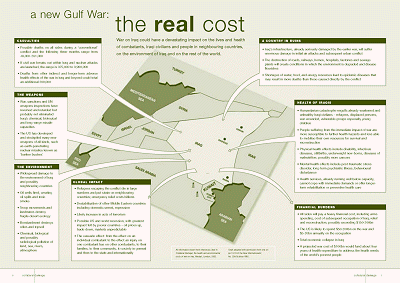
Right-click here to download full size map.
Click here to download "Collateral Damage: the health and environmental costs of war on Iraq"
New report shows likely casualties of up to half a million in short and long term from war on Iraq
A war on Iraq could cause half a million deaths and have a devastating impact on the lives, health and environment of the combatants, Iraqi civilians, and people in neighbouring countries and beyond, says an authoritative new report launched today in London and 13 other countries.
Researched and written by international health professionals, this evidence-based analysis examines the likely impact of a new war on Iraq from a public health perspective. Estimates of the total possible deaths on all sides during the conflict and the following three months range from 48,000 to over 260,000. Civil war within Iraq could add another 20,000 deaths. Additional later deaths from post-war adverse health effects could reach 200,000. If nuclear weapons were used the death toll could reach 3,900,000. In all scenarios the majority of casualties will be civilians.
The aftermath of a 'conventional' war could include famine and epidemics, millions of refugees and displaced people, and economic collapse in Iraq. Destabilisation and possible regime change in neighbouring countries and more terrorist attacks are possible. Global economic crisis may be triggered through trade reduction and soaring oil prices, with particularly devastating consequences for developing countries. The financial burden will be enormous on all sides, with arms spending, occupation costs, relief and reconstruction possibly exceeding $150-200bn.
The new report describes the most probable hypothetical war scenario based on information from leading US and UK military analysts. This forms the baseline for its projections from the 1990-91 Gulf War and comparable conflicts, and from the best available information on the current state of health in Iraq. This indicates that its people are far weaker mentally and physically than in 1990 and therefore less able to withstand new assaults on their health and find strength for recovery and reconstruction.
The main aim of this report is to aid decison-making and encourage informed public debate by spelling out the true cost of a new war, against which any potential gains from going to war must be weighed. It does not take a political stance on the alternatives to war, but lists non-violent strategies not yet fully explored - some relating specifically to Iraq, and some to improving the international security context.
/more follows �..
Sponsors
Jane Salvage, the report's author, will say that 'war is a huge public health issue. Casualties, the cycle of violence and other consequences continue to affect generation after generation. The structure of society deteriorates. Uncertainty and war itself affect regional and economic stability; displaced people become refugees in their own and other countries; and poor health hinders poverty reduction and sustainable development, which are preconditions for peace and prosperity.'
Medact President June Crown will point out: 'The world could benefit immensely if the more than $150 billion to be spent on the war were used in more productive ways. For example, this sum would fund about four years of health expenditure to address the health needs of the world's poorest people.'
The sponsors of the report, Medact and IPPNW, believe there is an urgent need for humane and wise global leadership which recognises that national security is impossible without international security. They urge all those concerned to pursue peaceful means of resolving conflicts with Iraq, and to think carefully about the effects of waging a war that might damage our fragile planet and its people for decades to come.
The report is also being issued today by affiliates of International Physicians for the Prevention of Nuclear War (IPPNW) in 13 other countries: Australia, Canada, Denmark, France, Germany, Guatemala, India, Japan, Malaysia, Netherlands, Norway, Philippines, and the United States.
Michael Christ, IPPNW Executive Director, recommends the following to prevent a human catastrophe:
� First Do No Harm -- the need to ensure that Iraq is disarmed of its weapons of mass destruction does not warrant an attack which will result in massive civilian and military casualties.
� Prohibit Pre-emptive Military Action -- the US should not launch a pre-emptive, unilateral war against Iraq, nor should the UN Security Council condone pre-emptive military action.
� Support Effective Inspections -- provide sufficient resources and backing to UN teams to ensure that the Iraqi regime is disarmed.
� Prevent Further Suffering -- a plan must be in place to ensure the supply food, water and basic services such as health care to the people of Iraq who, more than anyone else, have suffered under Saddam Hussein.
Sponsors
Available for interview at the UK launch will be:
Dr June Crown - President of Medact and former President of the Faculty of Public Health Medicine
Jane Salvage - international health consultant and author of the report
Mike Rowson - Director, Medact
Gill Reeve - Deputy Director, Medact (report co-ordinator)
More information from Medact, 020 7272 2020; [email protected]; www.medact.org
Click here to download "Collateral Damage: the health and environmental costs of war on Iraq"
<-- Return To SHRUBBED
Didn't find what you are looking for? We've been online since 1996 and have created 1000's of pages. Search below and you may find just what you are looking for.
Michael R. Meuser
Data Research & GIS Specialist
MapCruzin.com is an independent firm
specializing in GIS project development and data research.
We created the first U.S. based
interactive toxic chemical facility
maps on the internet in 1996 and we
have been online ever since. Learn more about us and our services.
Have a project in mind? If you have data, GIS project or custom shapefile needs contact Mike.
Contact Us
Report Broken Links
Subscribe for Updates
|