Introduction
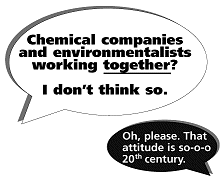
To your left is a portion of an Environmental Defense (ED) and Chemical Manufacturers Association (CMA) ad that the two organizations jointly released to annouce the voluntary High Production Volume (HPV) testing program. Partnerships like this and other business-friendly initiatives (commonsense, innovative permitting, reinvention, and the like) have grown over the last decade. The new republican administration is sure to build upon these.

Large environmental groups have become increasingly professional, increasingly wealthy (see Losing Ground: American Environmentalism at the Close of the Twentieth Century) and the foundations that fund these groups are relatively free of any democratic oversight (see American Foundations: An Investigative History.
It is time to begin discussing what environmentalism has become and what it should be in the 21st century. What works and what does not?
What is left out? Who is left out? Is environmentalism democratic? Is funding democratic ... ? Can we get there from here?
I have just begun to do research on this myself. I've listed some resources below and some books to the right from folks that have much to offer on the subject. These will be of help to us as we discover where we are, who we are, and where we are going.
Focus on Causes (updated 01/12/01)
The lists still are not yet complete. These are not "my"
lists. Rather, they reflect all the input I have received
from you. The focus I envision includes all the barriers
and the possible solutions to environmental-social
problems/issues -- focusing on the causes rather than the effects. This led to creating two big catergories --
"Barriers / Solutions" and "Health and Ecological
Issues." We can begin to ask why and how is such and
such a barrier and how can it be turned into a
solution with regard to the various issues. Some barriers
may become solutions through some sort of modification,
others through becoming their exact opposite. Many have
their opposite. For instance, corporate prepared
environmental education in the classroom is a barrier,
but more enlightened environmental education is part of
the solution. Same goes for the media, etc. Also, many
items mean different things to different folks. For
instance, some view sustainability as sustaining the
natural world, ecosystems and the like while others view
it as meaning sustaining human communities and the
natural world. Please send any modifications/additions.
If I have left out any of your additions, please resend.
The next step, of course, is to boil the list down, removing
duplications, overlaps, items that are too closely related and the like.
BARRIERS / SOLUTIONS
- Deep ecology movement
- Environmental justice movement
- Indigenous environmental movement
- Information and sophistication required for its access
- Environmental education
- Media attention, production, and interpretation
- Capitalism and "free" markets
- Military industrial complex
- Whistleblowers
- Globalization, world trade, GATT, NAFTA
- Professionalization of the environmental movement
- Partnering between environmental groups and polluters
- Lifestyle and personal consumption
- EPA and polluters as clients
- Regulatory reform
- Putting your money to work (walking the talk)
- Lobbying
- Steady state economies
- Political funding
- Technological change
- Information Warfare
- Interaction beween enviros, community groups,
regulators and industry
- Mainstream enviro-groups and community needs
- Role of foundations and funding
- Action networks on the web
- Role of government agencies
- Right to know
- Human health and medical professions
- Role of academic research institutions
- Legal system
- Wise use and anti-environmentalism
- Federal vs. state power
- Risk assessment
- Participation in decision-making
- Who sets the agenda?
- Economic growth
- Cost benefit analysis
- Environment and economy
- Issue specific list of groups who can be relied
upon to do the right thing
- Social cost/impact analyses
- Partnerships between environmentalists
and public health groups and organizations
- Environmental health education for medical
professionals, and communities
- Nonprofit advocacy rights
- Creating and promoting clean alternative technologies
- Eco-efficiency and stock market performance
- The Natural Step
- Eco-efficiency and green industries
- Local production for local consumption
- NIMBYism (not in my backyard)
- Property rights
- Population as cause and effect
- Funding mechanisms
- Private/public ownership of infrastructure
- corporate charters
HEALTH AND ECOLOGICAL ISSUES
- Poverty
- Global justice and equality
- Poor rural communities vs. major multinational
corporations
- Biotechnology
- Corporate profit and human health
- Environmentally mediated chronic illness; the variety
and causes
- Clearcutting forests
- Air quality
- Sprawl
- Alternative transportation
- Pesticides and health
- Energy consumption
- Renewable energy
- Environmental justice
- Protecting wildlife habitat
- Conservation of resources
- Human health and the increasing disease load directly
attributable to environmental contamination
- Water quality and quantity
- Sustainability
- Militarism and environment
- Health impacts of environmental injustice
- Children's environmental health
- Climate change
- Global warming
Education, Computers, Diversity & Sustainability
A subscriber to env21-l suggested that the item "Environmental education" is only the tip of the iceberg saying, "I think it's important to consider ALL institutional education as a barrier/solution and not just this... In other words, education for the global economy, the current dominant discourse in education which dwarfs any incarnation of environmental ed, is inherently unsustainable and anti-ecological." This very helpful person pointed me towards C. A. Bowers' works. I have located reviews for his latest books, Let Them Eat Data: How Computers Affect Education, Cultural Diversity, and the Prospects of Ecological Sustainability and The Culture of Denial: Why the Environmental Movement Needs a Strategy for Reforming Universities and Public Schools and a syllabus for his course. This is a good starting point for our discussion of the barriers to environmental solutions.
Closely related to the above is the question of whether or not the high costs of today's commercial internet -- sprawl, mindless irresponsibility, loss of capital, investment ruin, pollution, energy use, dislocation, increasing housing costs, eviction, and all the rest -- can ever be "balanced" by our more educational and activist uses of it.
Discussion
We have a new blog, feel free to post. I look foward to a lively discussion.
News
- ED (formerly EDF) and NRDC Censor and Limit Participation ... More
- THE NONPROFIT AGENDA: RECOMMENDATIONS TO PRESIDENT GEORGE W. BUSH (AL GORE) TO STRENGTHEN THE NONPROFIT SECTOR (OMBWatch) ... More
(note: the correct url to their survey is http://www.ombwatch.org/npadv/2000/survey.html)
- Environmental Defense's Fred Krupp Praises Christine Todd Whitman Choice for EPA head - Read the endorsement and a dissenting view ... More
- EPA Approves Emissions Trading Scheme ... More
- Removal of EPA Investigator Called Political Revenge: Why Gore really lost Ohio ... More
- Tempers Flare at Environmental Justice Conference ... More
- EPA Website Shutdown - Political
Analysis from OMB Watch ... More
- The Real Threat is the Internet and Environmentalism says the U.S. Chamber of Commerce ... More
- Industry Goes on Global Offensive Against Environmentalists" and related article, "Electronics Giant Tracks Environmental
Organisations" ... More
Corporations
- Public participation or public relations?" by Sharon Beder ... More
- The Intellectual Sorcery of Think Tanks by Sharon Beder ... More
Mainstream Environmentalism
Foundations
- The Dilemmas of Foundation-Backed Activism by Aaron G. Lehmer ... More
- Democratic Foundations: The future's best way to transfer wealth? By Mark Dowie ... More
Related Resources
- Seventh Generation Fund ... More
- Indigenous Environmental Network ... More
- California Indian Basketweavers Association ... More
- Several new articles about new EPA head Christine Todd Whitman ... More
- Creating Learning Communities ... More
Join the Learning Communities discussion by sending a blank email to:
LearningCommunities-subscribe@egroups.com
- CarFree Cities ... More
- Global Resource Bank ... More
- World Bank Greening Industry Report ... More
- Sustainable Development WebWorks ... More
- Environmental Justice Resources ... More
- NONPROFIT WATCH ... More
- Shrubbed - Bush and the Environment ... More
- Globalization and Trade ... More
- Read "N30: Skeleton Woman in Seattle" (Reprinted here with permission from the author) ... More
- Group of 77 South Summit ... More
Stay tuned. Much more coming.
Didn't find what you are looking for? We've been online since 1996 and have created 1000's of pages. Search below and you may find just what you are looking for.
MapCruzin.com is an independent firm
specializing in the publication of
educational and research resources.
We created the first U.S. based
interactive toxic chemical facility
maps on the internet in 1996 and we
have been online ever since. Learn more about us and view some of our projects and services.
If you have data, GIS project or custom shapefile needs send me an email.
Contact Us
Report Broken Links
Subscribe for Updates